What Is an Age Calculator — and Why Simple Math Gets It Wrong
Most people subtract their birth year from the current year and call it done. That works — until it doesn't. If your birthday hasn't happened yet this year, that number is off by one. And if you need your age for something that actually matters — a passport application, a medical form, school admission — being off by a year is a real problem.
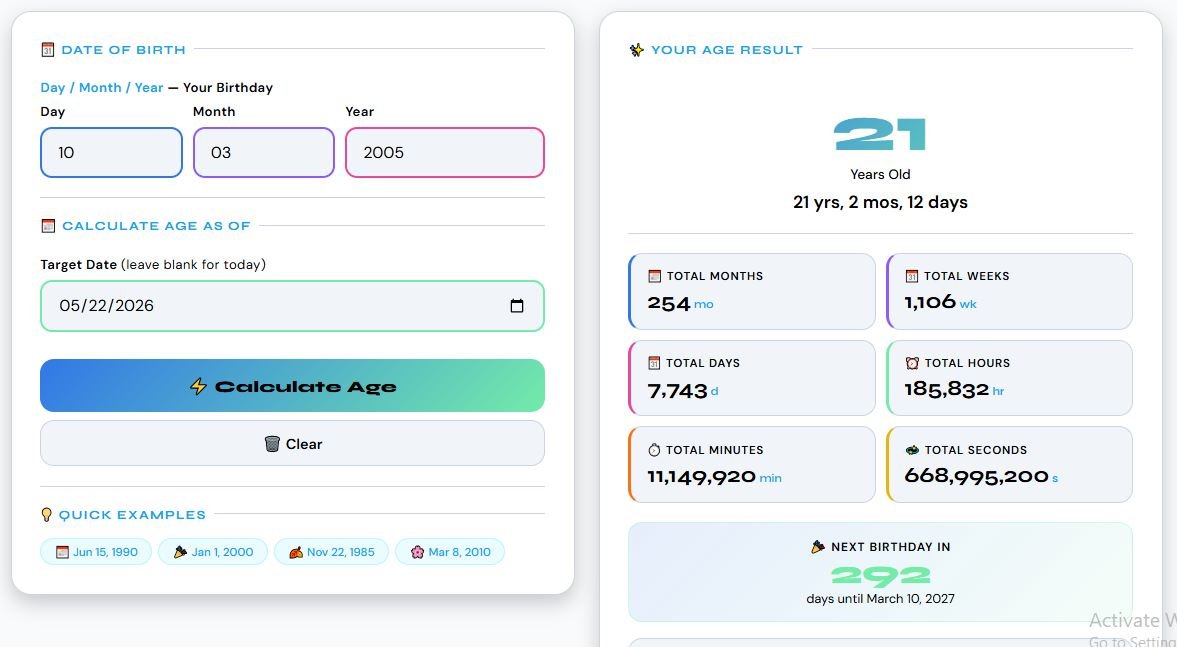
The age-calculator handles the full picture: it accounts for the exact calendar date, month lengths, and leap years, then breaks your age down into years, months, days, hours, minutes, and seconds. No signup, no ads, no data leaving your browser.
How to Use This Tool
Type your birth Day, Month, and Year into the three fields on the left. By default, the tool calculates your age as of today — but you can change the "Calculate Age As Of" date if you want to check how old you were (or will be) on a specific date. Hit Calculate Age and the results appear instantly on the right.
Along with your exact age, you'll also see your zodiac sign, Chinese zodiac animal, birthstone, birth flower, and the day of the week you were born on. There's a birthday countdown too — useful if you're closer to your next one than you think.
What You Get With Each Calculation
- Age broken into 6 units — years, months, days, hours, minutes, and seconds, all at once.
- Birthday countdown — exact days remaining until your next birthday.
- Western zodiac sign — Aries, Taurus, Gemini, and the rest, based on your birth date.
- Chinese zodiac animal — determined by your birth year in the 12-year cycle.
- Birthstone & birth flower — the traditional gem and flower for your birth month.
- Day of birth — the weekday you came into the world.
- Custom target date — check your age on any past or future date, not just today.
- One-click copy — export all your results to clipboard instantly.
Where Exact Age Actually Matters
For most casual purposes, knowing you're "around 34" is fine. But there are situations where the exact figure matters more than people realize. Pediatric health check-ups, for instance, use age in months — not years — for children under two. Many government schemes, insurance policies, and competitive exam eligibility cutoffs work the same way: the day matters, not just the year.
Beyond the practical side, there's something oddly satisfying about knowing you've been alive for, say, 12,847 days. If you're tracking health metrics alongside personal milestones, our BMI Calculator pairs well with this — knowing both your exact age and your body mass index gives you a clearer picture of where you stand health-wise. Similarly, students who need to track academic timelines alongside age might find our Grade Calculator useful for planning semester-by-semester progress.